

Change is all around us, and no more so, than in business today. If you drive transformational change across your organisation via projects and project managers, I have one important question for you:
Are your project managers trained in Change Management? If not, you could be leaving half your success on the table! Here’s why:
All Change is Personal.
The first thing to note is that all change is personal, and everyone’s reaction is profoundly subjective. It’s a roller-coaster journey of emotion where people experience loss before they can experience any gain. That’s why we see adaptations of the Kubler-Ross Stages of Grief model used across industry to describe how people cope with, and react to change. My favourite adaptation of the model is by John M Fisher below which voices the inner monologue at each emotion.

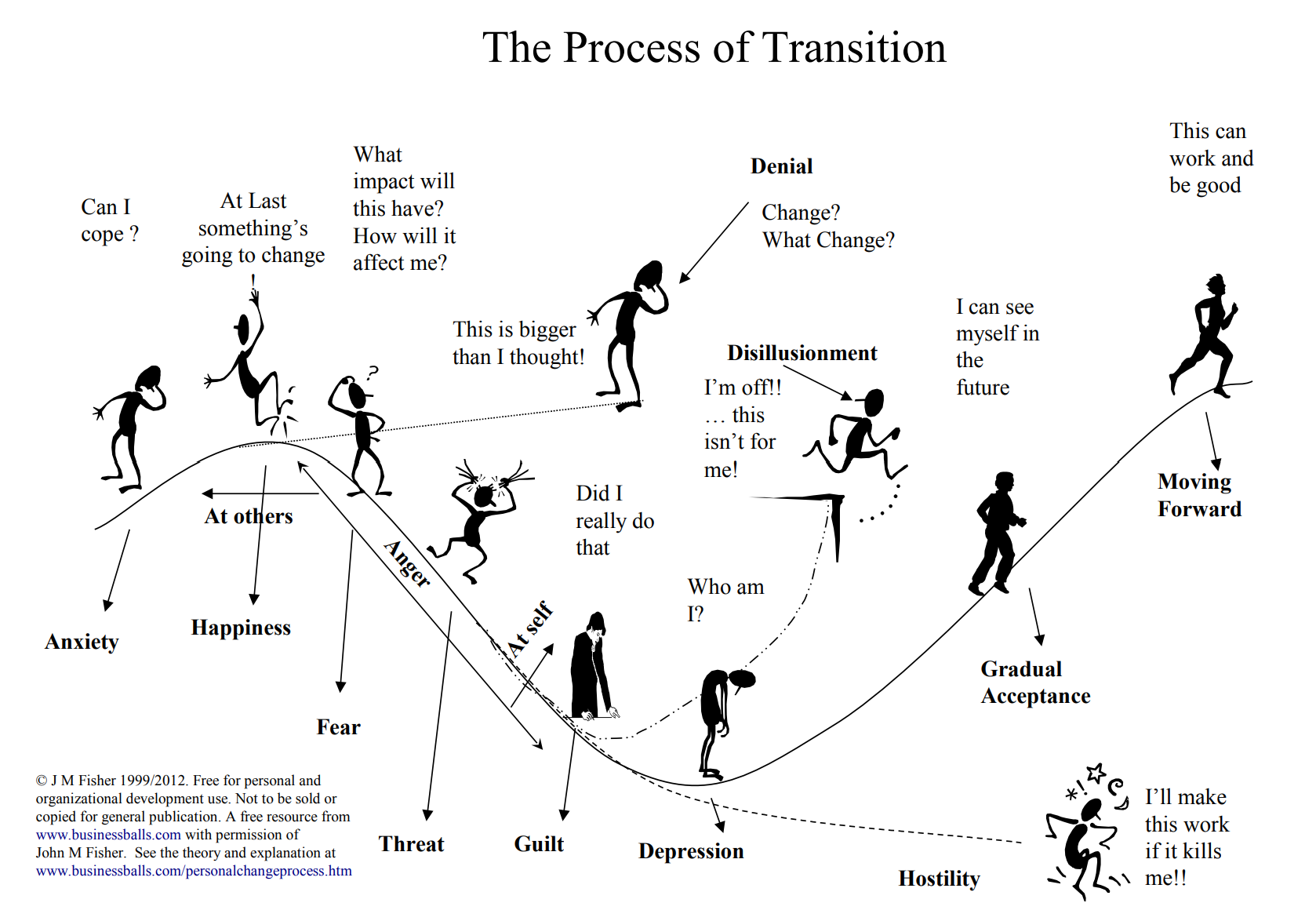
Companies don’t change, people do.
Humans are instinctively uncomfortable with change because we’ve evolved to believe stability equals security. People fondly look back with rose-tinted glasses and think “why are we changing something that works just fine?” It’s easier for our brains to understand well-worn tracks because we’ve built habits and intellectual short-cuts, placing them firmly in our comfort zone. But our greatest achievements happen outside our comfort zone, in what’s called the growth zone. The big question then becomes how do we inspire people to embrace the discomfort of change and look forward with optimism and acceptance, in pursuit of innovation, efficiency and personal fulfilment? Enter the discipline of Change Management!
Change Management + Project Management = Maximum success
There are two sides to driving successful change – the operational side of change and the people side of change. Project Management is designed to support the operational side, focusing on tangible and measurable factors like scope, stakeholder management, budget, resources, tools etc. Change Management supports the human side of change, supporting people’s emotional needs as well as business needs, and provides the motivation and support to get them from anxiety or resistance about the change, to acceptance and optimism about the future. The levers of Change Management are things like effective communications, team culture, growth mindsets, rewarding desired behaviours, and leading with empathy, to name just a few.
The most successful projects deliver outcomes that stand the test of time. This is done using an equal commitment to Project Management and Change Management. To assume your project managers are automatically change managers is a mistake; they are two separate disciplines with different (but complimentary) lifecycles. Think of it as two sides of a fabric, knitted together by a zip for maximum strength (Figure 2). Having a framework for change and a toolkit to support it, gives project managers the know-how and tools to be effective change advocates supporting people through every step of the change journey, delivering sustainable outcomes.

There is a very successful sales technique in the airline industry that says, “Sell the destination, not the plane”. While that might work for increasing flight sales, driving organisational change is more multi-faceted. When it comes to surviving and thriving in times of change, the journey is every bit as important as the destination. Train your project managers in Change Management to maximise your project success.
References
Fisher, J. M. (2017, June 9). John Fisher’s Personal Transition Curve – The Stages of Personal Change – and Introduction to Personal Construct Psychology. Retrieved from BusinessBalls.com: https://www.businessballs.com/change-management/personal-change-stages-john-fisher/
Kübler-Ross, E. (1969). On death and dying. New York: Macmillan Publishing Company.