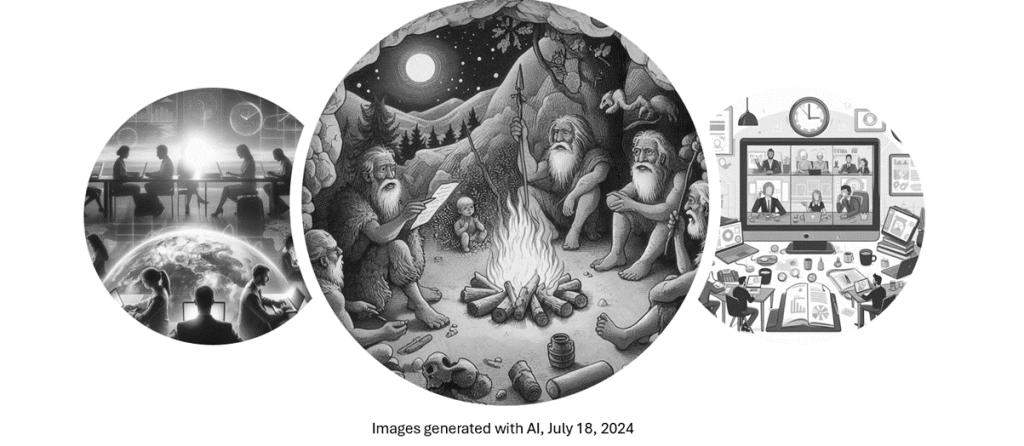
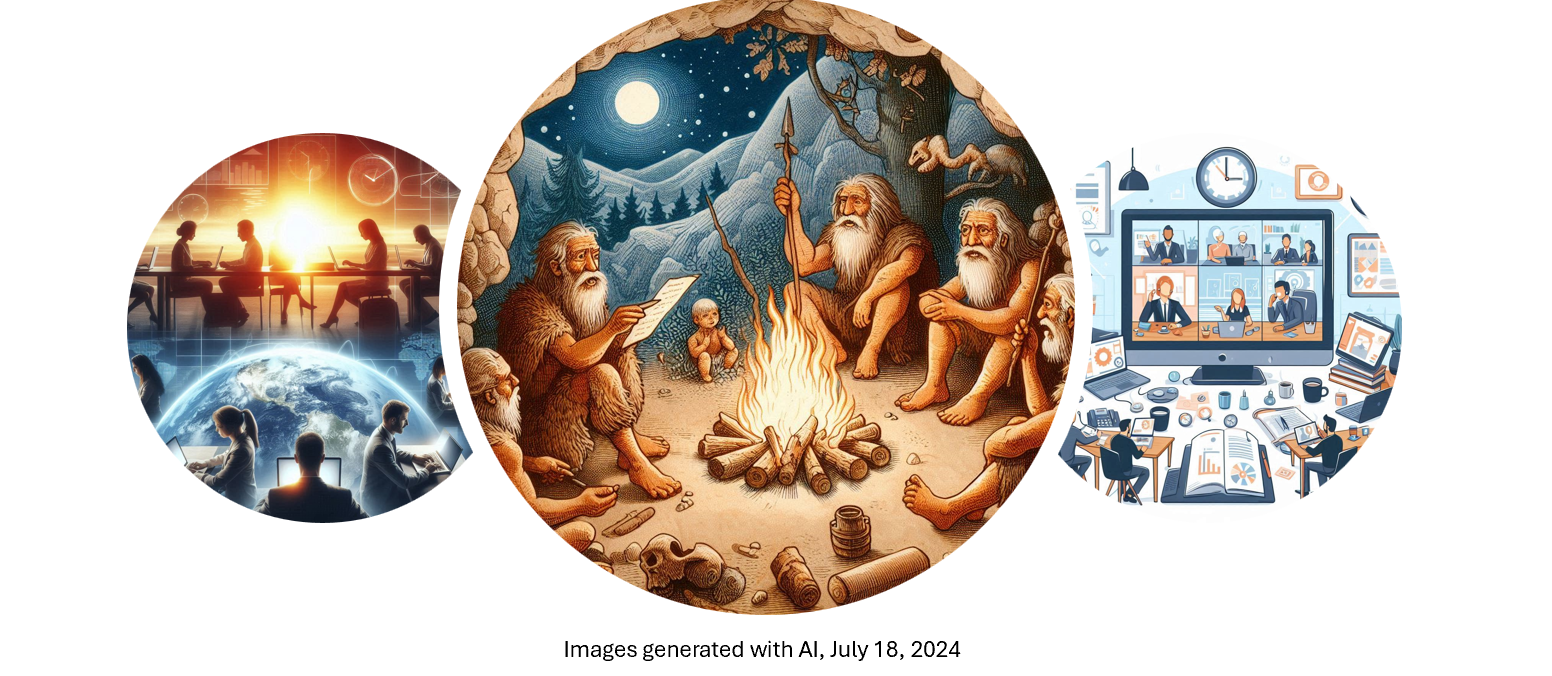
From ancient gatherings to modern-day methods for getting work done, meetings have played an important role in the human experience. Our sociological desire to meet, and our psychological need to feel a sense of belonging, has brought like-minded people together for millennia, helping each of us find our tribe. This intrinsic inclination to gather, in person or virtually, has evolved to become a double-edged sword in our modern work lives. Just because meetings have become the default method for getting work done, doesn’t mean it is always the best solution. Let’s explore how we got here and how we can influence where we are going next.
The ancient roots of gathering
Our ancient ancestors help us understand our deep-rooted relationship with meetings. Early humans gathered to share stories, pass down knowledge, and forge bonds. These meetings were essential for survival and cultural continuity. Storytelling might have been entertaining, but it was really a subtle and highly effective means of education, passing lessons from one generation to the next and creating group identity. These early meetings were rich with purpose.
The evolution of modern-day meetings
Fast forward to today and our love for meetings endures. In the modern workplace, meetings are ubiquitous, ranging from quick sync-up’s and brainstorming sessions, to methods of strategising, planning and decision-making. Meetings have become an expected part of our workday, but many have moved from a place of necessity, to one of overhead. Countless meetings today take place because we’ve always done it that way or because the calendar cadence has no end date. Most recurring meetings start out well-intended, to solve a specific and real problem, but over time become less productive through poorly defined goals, redundant discussions, declining attendance and vague outcomes.
The cost of unproductive meetings is high
Calendars filled with back-to-back meetings fuels our subconscious need to be busy, but it doesn’t necessarily make us busy on the right things. Even if we ignore the hourly cost of the people in the meeting, the opportunity cost of what else they could be working on during that time, consider the administrative cost of trying to sync calendars, the time that goes into preparing for these meetings, the slideware, dry-runs, draft reviews and meeting minutes. Unproductive meetings not only affect productivity, but also impact employee morale. How often have you sat through a 1-hour meeting, waiting for the 5-minutes that’s relevant to you. Time has become our most precious resource so we must use it wisely.
Finding the Balance: Meetings and Asynchronous Work
Meetings are a form of synchronous work, meaning the people involved collaborate on the same work, in the same way, at the same time. Recent advancements in collaboration software means we are no longer limited to working in this traditional way. People and teams can collaborate very effectively now on the same work, but at different times and in different ways. It allows people to contribute at a time that suits them and work in a way that works for them, creating more personalised and customised work experiences. A new workstyle is emerging. This is known as asynchronous work, and it is very effective for globally distributed teams with shared work. It’s also a more inclusive way of working because it enables individuals to get their work done flexibly around important family, religious or personal wellbeing commitments.
By running less meetings and leveraging asynchronous communication and asynchronous collaboration, we can ensure our meetings remain purposeful and productive, and deep work gets achieved through uninterrupted flow.
Conclusion
Our relationship with meetings is complex. If it were easy, we would have solved it already. Meetings are deeply ingrained in our history and will continue to play an important role in our future, after all, nothing motivates action quite like an upcoming meeting. But a strength overplayed is a weakness. Today’s modern and digitally enabled workplace has another method for getting work done. It’s called asynchronous work.
For more on Asynchronous work and how to implement it read more.
 gillian bergin